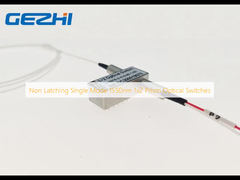
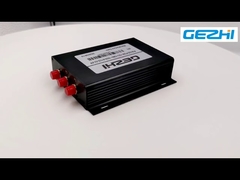
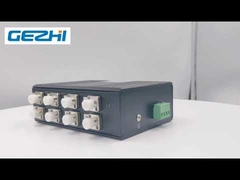
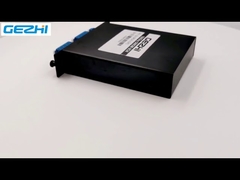
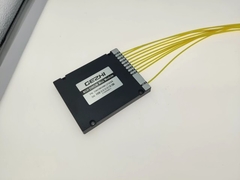
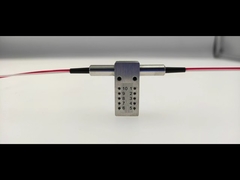
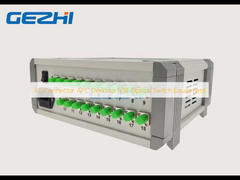
Brief: Thinking about an upgrade? This short demo helps you evaluate the fit. Watch as we demonstrate the GEZHI Dual 1x2 / 2x4 Fiber Optic Switch in action, showing how it redirects optical signals between channels. You'll see its PCB mountable design and learn about its applications in R&D labs, Metropolitan Area Networks, and Configurable OADM systems.
Related Product Features:
Dual 1x2 / 2x4 configuration with six fibers and two states for flexible optical channel routing.
Operates at wavelengths of 1310nm and 1550nm with a wide range from 1260nm to 1620nm.
Features low insertion loss, typically 0.7dB and maximum 1.0dB, ensuring signal integrity.
High return loss of ≥50dB for single-mode and ≥30dB for multi-mode fibers minimizes back reflections.
Non-latched 3V voltage operation with a fast switch time of ≤8ms for rapid signal redirection.
Epoxy-free optical path design enhances reliability and long-term stability.
Compact PCB mountable size of 27.0×12×8.2mm for easy integration into systems.
Robust operating life of ≥10^7 cycles and power handling up to 500mW for demanding applications.
প্রশ্নোত্তর:
What are the primary applications for the GEZHI Dual 1x2 Fiber Optic Switch?
This fiber optic switch is primarily used in R&D laboratories, Metropolitan Area Networks (MAN), system monitoring, and Configurable Optical Add-Drop Multiplexers (OADM) for redirecting optical signals between channels.
What wavelengths does this fiber optic switch support?
The switch supports wavelengths of 1310nm and 1550nm, with a broad operating wavelength range from 1260nm to 1620nm, making it versatile for various optical communication systems.
What is the insertion loss and how does it affect performance?
The insertion loss is typically 0.7dB with a maximum of 1.0dB. Low insertion loss ensures minimal signal attenuation, which is critical for maintaining high signal quality and system performance over the optical network.
Is customization available for this fiber optic switch?
Yes, customization is available. You can specify options for wavelength, voltage type, control model, fiber type, diameter, length, and connector type using the provided order information format.